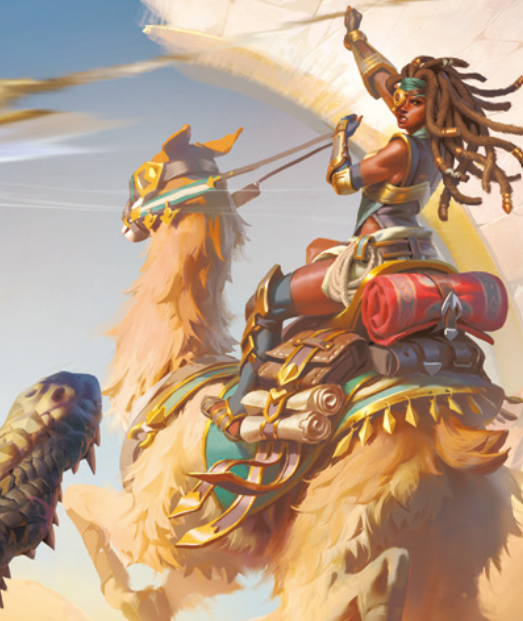
Elder Dragon

Card Text & Abilities
Any amount of your damage is enough to kill enemy units. When you play me, choose up to one enemy unit at each location. Deal 1 to them.
Judge Rulings & Interactions
5 Judge RulingsYou must assign lethal damage to one unit before assigning damage to another, and you cannot assign more than the lethal minimum while another unit remains. With Elder Dragon, that normally means assigning exactly 1 damage to an enemy unit before moving to the next. Passive abilities and replacement effects, including prevention, are considered during assignment and can change this minimum.
Elder Dragon vs. Imperial Decree
Suppose Pakaa Cub, with 3 might, is your only attacker against three undamaged copies of Noxus Hopeful, each defending with 4 might. With Elder Dragon, you assign 1 damage from Pakaa Cub to each Noxus Hopeful, and all three are killed during the combat cleanup.
Imperial Decree does not change lethal damage or combat damage assignment. Assigning damage is not dealing damage, so its delayed triggered ability triggers only after a unit actually takes damage and then attempts to kill that unit.
With Imperial Decree instead, Pakaa Cub still assigns all 3 damage, but you cannot split it among the three Noxus Hopefuls. You must assign lethal damage to one before moving to another, so all 3 damage is assigned to the Noxus Hopeful you choose first. Of the three Noxus Hopefuls, only that one takes Pakaa Cub's combat damage, so Imperial Decree's kill ability triggers for it and not the other two.
Finalizing a unit does not pass priority, and the unit resolves immediately. After Elder Dragon enters, a cleanup happens without passing or awarding priority, and every unit with lethal damage is killed unless that death is replaced. Elder Dragon's separate "When you play me" ability is a triggered play effect, but it does not create a response window before this lethal-damage check.
Example
You play Flurry of Blades during your turn, and its 1 damage remains marked on enemy units at battlefields. When you later play Elder Dragon directly, each of those units is killed in the cleanup caused by Elder Dragon entering before your opponents can react.
The same result occurs if Dazzling Aurora plays Elder Dragon at the end of your turn. End-of-turn abilities happen in the Ending Step, before the Expiration Step's special cleanup heals all units, so reaching the end of the turn has not itself healed Flurry of Blades' damage yet. Opponents may react while Dazzling Aurora's triggered ability waits to resolve. Once that ability begins resolving and reveals Elder Dragon, no new priority window opens before Elder Dragon enters and the affected units are killed.
Elder Dragon enters, and its passive makes your marked damage lethal to the damaged enemy unit. Its play effect is then added to the chain as a pending item.
Both Elder Dragon entering and its play effect being added require cleanup before play continues. All outstanding cleanups finish before the pending effect can begin finalization.
During cleanup, the damaged unit would be killed. Zhonya's Hourglass replaces that death: the Hourglass is killed instead, and the unit is healed, exhausted, and recalled to its controller's base rather than killed.
Killing Zhonya's Hourglass sends it from the board to the trash, making another cleanup outstanding after the current one.
After all cleanups finish, you choose targets while finalizing the play effect. The recalled unit is now in base, and any valid enemy unit that remains at a battlefield is at a different location, so both can be chosen.
When the effect resolves, it deals 1 to each target it affects, marking damage on each unit separately. If Elder Dragon remains on the board, its passive makes that damage lethal, so each affected unit would be killed during the cleanup after the ability leaves the chain.
After Elder Dragon enters, its play effect is added to the chain before the resulting cleanup. Elder Dragon's passive ability makes its controller's marked damage on enemy units lethal, so that cleanup may kill an opponent's last units. The pending play effect remains on the chain throughout the cleanup, so the opponent retains control of their empty battlefields and their Hidden cards remain there. After the play effect finalizes with zero targets, the opponent may play an eligible card from face down as a Reaction before the effect resolves. When the effect resolves with no targets, it simply does nothing.
Official Rules FAQ & Clarifications
3 Official FAQsElder Dragon’s play effect has a number of targeting restrictions equal to the number of locations on the board. Its controller chooses up to one enemy unit at each of those locations to target with the ability and each of those units must follow their respective targeting restriction. It is the equivalent to saying “Deal 1 to up to one enemy unit at battlefield A. Deal 1 to up to one enemy unit at battlefield B. Deal 1 to up to one enemy unit in your base. Deal 1 to up to one enemy unit in Opponent A’s Base. …” Each of those targeting restrictions is fulfilled separately for each unit targeted.
If you play Flash in reaction to the play effect of Elder Dragon, any units that are moved to a location other than the one where they were targeted will no longer fulfill the targeting restriction of the Elder Dragon play effect and will be unaffected by the ability as it resolves.
In general, there are not many cases where we have this kind of competing instruction: one effect that tells you to play a unit to one location, and one that tells you to play it to another. That being said, when they do arise with contradictory requirements, the precedent from other areas of the rules is that the player chooses one of those requirements and ignores all others.
Note that this only applies to mandatory positive requirements, ones that specify a location or method without also preventing the action from being performed to other locations or with other methods and that aren’t optional. For example, an effect like Perched Grimwyrm’s passive ability is a restriction on playing that unit to any location other than a battlefield you’ve conquered this turn. Rockfall Path’s passive ability is a restriction on playing units to Rockfall Path. If you’ve conquered only Rockfall Path this turn, you can’t play Perched Grimwyrm at all, because those two restrictions are contradictory.
In this case, the contradictory requirements don’t directly prohibit the playing of these units to other locations, so we can choose one of the contradictory requirements and ignore the rest.
Per the current rules, there is nothing that would stop Imperial Decree’s delayed trigger from triggering Immortal Phoenix. It is a triggered ability generated by a spell; it is attributed a kill action, and thus the spell that generated it will also be attributed the same kill action. The owner of Imperial Decree is the controller of the delayed triggered ability; the player responsible for the kill action is the one who controls the ability; and that same player is the owner of Immortal Phoenix in the Trash. Thus all three conditions for Immortal Phoenix triggering are complete, and it will trigger.